artatopics
Forecasting 251 research fields from planetary positions only. Every test: fit on data ≤1995, graded on 1996–2025 the model never saw, against do-nothing baselines. Scores: 1.0 = perfect, 0 = no better than the field's long-run average. Full code and data: github.com/ArtaQuest/artatopics.
1 · The deployed model — one receiver for all of science
y_field(t) = | bfield + Afield Σi ai · e i(θi(t) − pfield,i) |²
What each symbol is. θi(t) is the position of planet i (Mars, Jupiter, Saturn, Uranus, Neptune, Pluto, lunar node) in year t — known centuries ahead, which is the only reason a thirty-year forecast is possible at all. Each planet contributes an arrow rotating in the plane at its own orbital rate. The arrow lengths ai are global: one spectrum, shared by every one of the 251 fields. A field owns exactly three personal things: a level b (its resting brightness), a gain A (how loudly it hears the shared spectrum), and seven phases pi — where each planet must stand to push it hardest. The phases are the field's identity — its signs. The predicted share is the squared length of the total arrow: bright when the planets gang up on the field's phases, dim when they cancel.
Why the square matters. Squaring the total arrow expands exactly — not approximately — into a baseline, seven transit terms (2bA·ai·cos(θi−pi), one planet crossing the field's phase) and twenty-one aspect terms (2A²aiak times the cosine of the pair's separation against the pair's phases). Those are linear in fixed functions of the date, so the model fits by least squares in closed form — no optimiser, no random seed; refit it anywhere and the same numbers come out. The per-field level and gain then solve exactly too: each is the root of a cubic. Two footnotes the fit forced on us, kept in the code: the slowest features barely move inside a 296-year window, so a small ridge (chosen on early origins only) is needed to keep the coefficients identifiable; and scale is each field's own historical level — measured from its data, never fitted.
How it is tested. Fit on everything up to 1995; forecast 1996–2025 blind; score against carrying the field's average forward — and repeat from twelve different cut-off years so no single lucky window decides anything. The same discipline as every number on this page.
The global arrows: mars 0.012 · jupiter 0.017 · saturn 0.035 · uranus 0.080 · neptune 0.050 · pluto 0.048 · node 0.022. Honest comparison: the best per-field model in this repository (each field also fitting its own arrow lengths) scores 0.88 / 0.80 on the same tests, and "carry today forward" scores 0.85 / 0.73 — this model beats carry-forward at the 30-year wall.
The data and the fit

Blue = the field's actual share of each year's citations. Gold = this model: solid where it was fitted (≤1995), dashed where it forecasts. The 8% Artificial Intelligence spike in 1868 is real data but thin evidence — 369 citations existed that year in total — and carries almost no weight in the fit.
Every field, same picture:
2 · The per-field reference model, 30-year forecast
3 · The share of attention across all fields at once
| strategy | error ↓ |
|---|---|
| copy yesterday's distribution | 0.083 |
| per-field model, renormalised | 0.085 |
| best combined planet model | 0.088 |
| softmax (convex, provably optimal) | 0.110 |
Copying yesterday wins. Fields drift one way (AI grows, old fields shrink); periodic signals cannot encode drift. Verified not to be a training issue: loss, model form, phase count and topic roster all varied — ranking unchanged.
4 · "Will it trend next year?" — one predictor per field, trained by least squares, called at the field's median
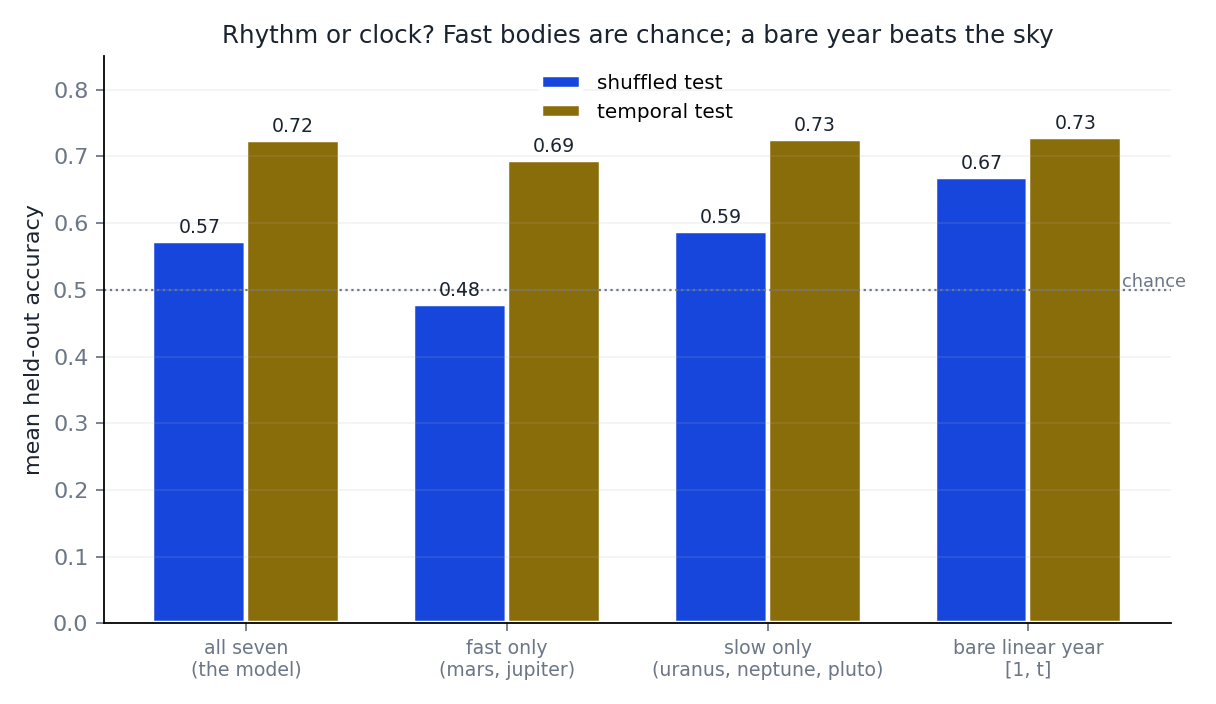
Controls: fast planets only → 48% (chance). Slow planets only → 59%. Calendar year alone → 67%, better than the sky. The accuracy is calendar signal carried by the slow planets, not planetary rhythm.
Per-field calls
| field | call | accuracy |
|---|---|---|
| Health Informatics | yes | 86% |
| Biomaterials | yes | 85% |
| Structural Biology | yes | 80% |
| Pollution | yes | 79% |
| Orthodontics | yes | 79% |
| Experimental and Cognitive Psychology | yes | 78% |
| Cultural Studies | yes | 78% |
| General Decision Sciences | yes | 78% |
| Software | yes | 75% |
| Algebra and Number Theory | yes | 75% |
| Human Factors and Ergonomics | yes | 75% |
| Pathology and Forensic Medicine | yes | 74% |
| Reproductive Medicine | yes | 74% |
| Clinical Psychology | yes | 74% |
| Geography, Planning and Development | yes | 74% |
| Immunology | yes | 74% |
| Otorhinolaryngology | yes | 74% |
| Information Systems | yes | 73% |
| Biological Psychiatry | yes | 73% |
| General Social Sciences | yes | 73% |
| Management Information Systems | yes | 72% |
| Media Technology | yes | 72% |
| Computational Mechanics | yes | 71% |
| Inorganic Chemistry | yes | 70% |
| Mechanics of Materials | yes | 70% |
| Electronic, Optical and Magnetic Materials | yes | 70% |
| Mathematical Physics | yes | 70% |
| Rehabilitation | yes | 70% |
| Accounting | yes | 70% |
| Spectroscopy | yes | 70% |
| Geometry and Topology | yes | 70% |
| Atomic and Molecular Physics, and Optics | yes | 70% |
| Sensory Systems | yes | 69% |
| Catalysis | yes | 68% |
| Environmental Engineering | yes | 68% |
| Water Science and Technology | yes | 68% |
| Genetics (Medicine) | yes | 68% |
| Computational Theory and Mathematics | yes | 68% |
| Obstetrics and Gynecology | yes | 68% |
| Ecology | yes | 68% |
| Industrial and Manufacturing Engineering (Environmental Science) | yes | 67% |
| Biochemistry (Medicine) | yes | 67% |
| Hematology | yes | 67% |
| Developmental Neuroscience | yes | 67% |
| Law | yes | 65% |
| Computer Vision and Pattern Recognition | yes | 65% |
| Mechanical Engineering | yes | 65% |
| Pediatrics, Perinatology and Child Health | yes | 65% |
| Psychiatry and Mental health | yes | 65% |
| Neurology (Neuroscience) | yes | 65% |
| Statistical and Nonlinear Physics | yes | 65% |
| Speech and Hearing | yes | 65% |
| Animal Science and Zoology | yes | 65% |
| Statistics, Probability and Uncertainty | yes | 65% |
| Nephrology | yes | 65% |
| Cellular and Molecular Neuroscience | yes | 65% |
| Nutrition and Dietetics | yes | 65% |
| Developmental and Educational Psychology | yes | 65% |
| Small Animals | yes | 65% |
| Microbiology (Medicine) | yes | 64% |
| Religious studies | yes | 64% |
| General Health Professions | yes | 64% |
| Organizational Behavior and Human Resource Management | yes | 64% |
| Atmospheric Science | yes | 64% |
| General Economics, Econometrics and Finance | yes | 64% |
| Ophthalmology | yes | 64% |
| Behavioral Neuroscience | yes | 64% |
| Pharmacy | yes | 64% |
| Soil Science | yes | 63% |
| Astronomy and Astrophysics | yes | 63% |
| History | yes | 62% |
| Molecular Biology | yes | 62% |
| Neuropsychology and Physiological Psychology | yes | 62% |
| Pharmacology (Medicine) | yes | 62% |
| Information Systems and Management | yes | 61% |
| Automotive Engineering | yes | 61% |
| Polymers and Plastics | yes | 61% |
| Numerical Analysis | yes | 61% |
| Orthopedics and Sports Medicine | yes | 61% |
| Public Administration | yes | 61% |
| General Arts and Humanities | yes | 61% |
| Strategy and Management | yes | 61% |
| Dermatology | yes | 61% |
| Physiology (Medicine) | yes | 61% |
| Pulmonary and Respiratory Medicine | yes | 61% |
| Radiology, Nuclear Medicine and Imaging | yes | 61% |
| Education | yes | 61% |
| Ecology, Evolution, Behavior and Systematics | yes | 60% |
| Biotechnology | yes | 60% |
| Clinical Biochemistry | yes | 60% |
| Process Chemistry and Technology | yes | 60% |
| Electrochemistry | yes | 60% |
| Industrial and Manufacturing Engineering (Engineering) | yes | 60% |
| Architecture | yes | 60% |
| Virology | yes | 60% |
| Ceramics and Composites | yes | 60% |
| Metals and Alloys | yes | 60% |
| Family Practice | yes | 60% |
| Oral Surgery | yes | 60% |
| Philosophy | yes | 59% |
| Economics and Econometrics | yes | 59% |
| Management of Technology and Innovation | yes | 59% |
| Endocrinology, Diabetes and Metabolism | yes | 59% |
| Rheumatology | yes | 59% |
| Transportation | yes | 59% |
| Demography | yes | 59% |
| Surfaces, Coatings and Films | yes | 59% |
| Internal Medicine | yes | 59% |
| Aging | yes | 58% |
| Geology | yes | 58% |
| Pharmaceutical Science | yes | 58% |
| Radiation | yes | 58% |
| Communication | yes | 58% |
| Complementary and Manual Therapy | yes | 58% |
| Occupational Therapy | yes | 58% |
| Biochemistry (Biochemistry, Genetics and Molecular Biology) | yes | 57% |
| Cell Biology | yes | 57% |
| Applied Microbiology and Biotechnology | yes | 57% |
| Materials Chemistry | yes | 57% |
| Applied Psychology | yes | 57% |
| Music | yes | 57% |
| Artificial Intelligence | yes | 57% |
| Finance | yes | 57% |
| Global and Planetary Change | yes | 57% |
| Epidemiology | yes | 57% |
| Health | yes | 57% |
| Tourism, Leisure and Hospitality Management | yes | 56% |
| Signal Processing | yes | 56% |
| General Energy | yes | 56% |
| Instrumentation | yes | 56% |
| Gastroenterology | yes | 56% |
| Urology | yes | 55% |
| Emergency Medical Services | yes | 55% |
| Conservation | yes | 55% |
| Hardware and Architecture | yes | 55% |
| Gender Studies | yes | 55% |
| Urban Studies | yes | 55% |
| Social Psychology | yes | 54% |
| Horticulture | yes | 54% |
| Museology | yes | 54% |
| Discrete Mathematics and Combinatorics | yes | 53% |
| Agronomy and Crop Science | yes | 53% |
| Management Science and Operations Research | yes | 53% |
| Periodontics | yes | 53% |
| Marketing | yes | 52% |
| Paleontology | yes | 52% |
| Oncology | yes | 52% |
| Physical Therapy, Sports Therapy and Rehabilitation | yes | 52% |
| Food Science | yes | 52% |
| Ocean Engineering | yes | 52% |
| Emergency Medicine | yes | 52% |
| Neurology (Medicine) | yes | 52% |
| Nature and Landscape Conservation | yes | 52% |
| General Agricultural and Biological Sciences | yes | 50% |
| Forestry | yes | 50% |
| Classics | yes | 50% |
| Literature and Literary Theory | yes | 50% |
| Endocrinology | yes | 50% |
| Genetics (Biochemistry, Genetics and Molecular Biology) | yes | 50% |
| Industrial relations | yes | 50% |
| Bioengineering | yes | 50% |
| Filtration and Separation | yes | 50% |
| Fluid Flow and Transfer Processes | yes | 50% |
| Computer Science Applications | yes | 50% |
| Space and Planetary Science | yes | 50% |
| Safety, Risk, Reliability and Quality | yes | 50% |
| Building and Construction | yes | 50% |
| Theoretical Computer Science | yes | 50% |
| Critical Care and Intensive Care Medicine | yes | 50% |
| Geriatrics and Gerontology | yes | 50% |
| Hepatology | yes | 50% |
| Surgery | yes | 50% |
| Leadership and Management | yes | 50% |
| Research and Theory | yes | 50% |
| Pharmacology (Pharmacology, Toxicology and Pharmaceutics) | yes | 50% |
| Linguistics and Language | yes | 50% |
| Safety Research | yes | 50% |
| Anthropology | yes | 50% |
| Biomedical Engineering | yes | 48% |
| Civil and Structural Engineering | yes | 48% |
| Infectious Diseases | yes | 48% |
| Archeology (Social Sciences) | yes | 48% |
| Computer Networks and Communications | yes | 48% |
| Renewable Energy, Sustainability and the Environment | yes | 48% |
| Health, Toxicology and Mutagenesis | yes | 48% |
| Microbiology (Immunology and Microbiology) | yes | 48% |
| Complementary and alternative medicine | yes | 48% |
| Applied Mathematics | yes | 47% |
| Anesthesiology and Pain Medicine | yes | 47% |
| Equine | yes | 47% |
| Health Information Management | yes | 47% |
| Political Science and International Relations | yes | 47% |
| Physiology (Biochemistry, Genetics and Molecular Biology) | yes | 47% |
| Cognitive Neuroscience | yes | 45% |
| Plant Science | yes | 45% |
| Earth-Surface Processes | yes | 45% |
| Geochemistry and Petrology | yes | 45% |
| Control and Systems Engineering | yes | 45% |
| Parasitology | yes | 45% |
| Cardiology and Cardiovascular Medicine | yes | 45% |
| Developmental Biology | yes | 44% |
| Public Health, Environmental and Occupational Health | yes | 44% |
| Chemical Health and Safety | yes | 44% |
| Radiological and Ultrasound Technology | yes | 44% |
| Language and Linguistics | yes | 42% |
| Management, Monitoring, Policy and Law | yes | 42% |
| Sociology and Political Science | yes | 41% |
| Aquatic Science | yes | 40% |
| Human-Computer Interaction | yes | 40% |
| Energy Engineering and Power Technology | yes | 40% |
| Life-span and Life-course Studies | yes | 38% |
| Visual Arts and Performing Arts | yes | 38% |
| Business and International Management | yes | 36% |
| Archeology (Arts and Humanities) | yes | 35% |
| Toxicology | yes | 35% |
| Analytical Chemistry | yes | 35% |
| History and Philosophy of Science | yes | 34% |
| Insect Science | yes | 33% |
| Computational Mathematics | yes | 33% |
| Medical Laboratory Technology | yes | 31% |
| Statistics and Probability | yes | 26% |
| Molecular Medicine | yes | 25% |
| Electrical and Electronic Engineering | yes | 24% |
| Transplantation | yes | 23% |
| Acoustics and Ultrasonics | no | 100% |
| Biophysics | no | 80% |
| Aerospace Engineering | no | 74% |
| Modeling and Simulation | no | 69% |
| Computer Graphics and Computer-Aided Design | no | 67% |
| Nuclear Energy and Engineering | no | 67% |
| Development | no | 67% |
| General Psychology | no | 65% |
| General Dentistry | no | 64% |
| Ecological Modeling | no | 63% |
| Immunology and Allergy | no | 63% |
| Oceanography | no | 61% |
| Cancer Research | no | 60% |
| Issues, ethics and legal aspects | no | 60% |
| Geophysics | no | 59% |
| General Engineering | no | 57% |
| Environmental Chemistry | no | 55% |
| Nuclear and High Energy Physics | no | 53% |
| Library and Information Sciences | no | 53% |
| Medical Terminology | no | 53% |
| Endocrine and Autonomic Systems | no | 50% |
| Physical and Theoretical Chemistry | no | 48% |
| Anatomy | no | 48% |
| Organic Chemistry | no | 45% |
| Fuel Technology | no | 44% |
| Condensed Matter Physics | no | 38% |
| General Materials Science | no | 30% |
5 · The competition — four GPU model families vs two do-nothing baselines
The whole campaign was then run as an open benchmark: a public Kaggle dataset, four competing model families trained on separate GPU accounts, scored blind on the ArtaQuest platform. Best selected model: a stack blending a damped trend with the sky receiver above (−2.09); a plain damped trend scores −2.04; every single-family GPU model loses to the baselines. The full board, the era-shift finding behind it, and a lab that rebuilds the winner in your browser (Pyodide): the ensemble stack →
6 · The exact phasor, solved analytically, on the daily record
The model above, |b + Σaᵢei(θᵢ−pᵢ)|², solved in closed form for b, aᵢ, pᵢ from the sky alone (kerykeion sidereal, cross-checked against three engines) and tested day by day on every arXiv submission since 1991: peak-detection AUC 0.49–0.50 across 127 categories, infeasible in 78% unregularised, and under L2 the inner walls shrink the arrows to nothing in 118 of 127. On the yearly share task the exact form scores −8.25 where the record's √-linear approximation scores −3.58 — the approximation was carrying it. A lab runs the closed-form solve in your browser: the exact phasor →